AI call centre software is rapidly becoming the secret engine behind exceptional customer experiences. By leveraging contact center artificial intelligence for omnichannel success, businesses can reduce long wait times, eliminate repetitive questions, and prevent agent burnout. Additionally, virtual agents enhance customer service by delivering fast, personalised, and consistent support around the clock. The result is happier customers, more productive teams, and lower operational costs.
This guide explains what AI call centre software is, the benefits it delivers, the capabilities to look for, and how to successfully introduce it into your operation.
Modern organisations increasingly rely on emerging technology for business growth to stay competitive. Smart systems and AI-powered tools allow companies to streamline operations and deliver faster customer support. Similarly, investing in advanced computing for large-scale projects enables businesses to handle complex data efficiently, providing insights that improve personalised customer interactions.
Marketing strategies are essential to ensure AI-powered support reaches the right audience. Using effective online marketing for customer retention helps companies align their automated support with messaging that resonates across digital channels. Additionally, digital marketing strategies to increase engagement allow businesses to leverage analytics, anticipate customer needs, and reduce response times, creating a seamless experience for every interaction.
Financial planning is also key for sustainable growth. By utilising reliable finance resources for business planning, managers can monitor ROI, optimise budgets, and ensure that AI call centre software investments deliver measurable results. Combining technology, marketing, and finance insights enables organisations to create smarter, more responsive contact centres that benefit both customers and teams.
Top 10 AI Call Centre Software Solutions for Modern Contact Centers
Choosing the right AI call centre software can transform customer service, boost agent productivity, and streamline operations. Here’s a list of the top 10 solutions, starting with Bright Pattern and followed by notable competitors in the space.
1. Bright Pattern – AI Contact Center Call Center Solutions
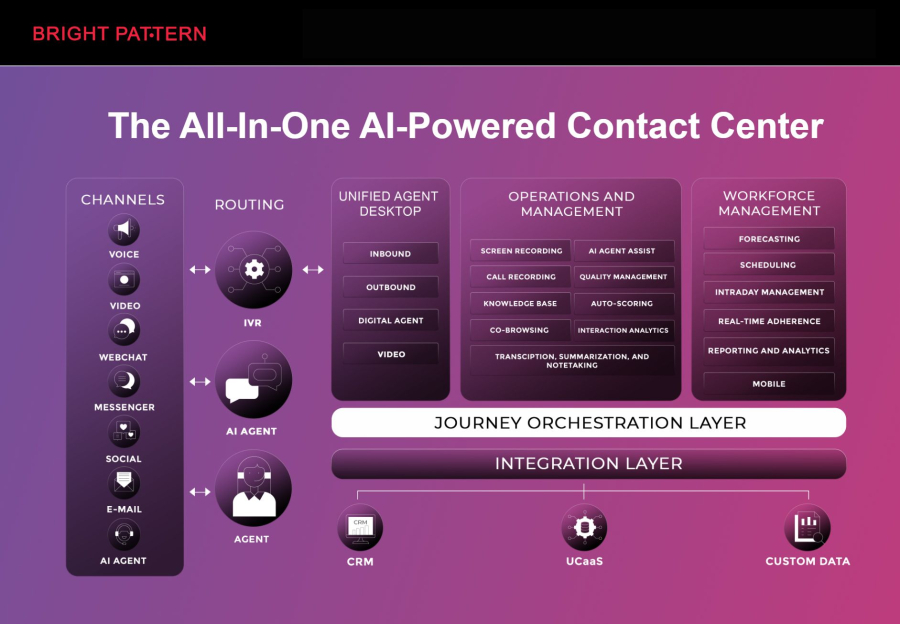
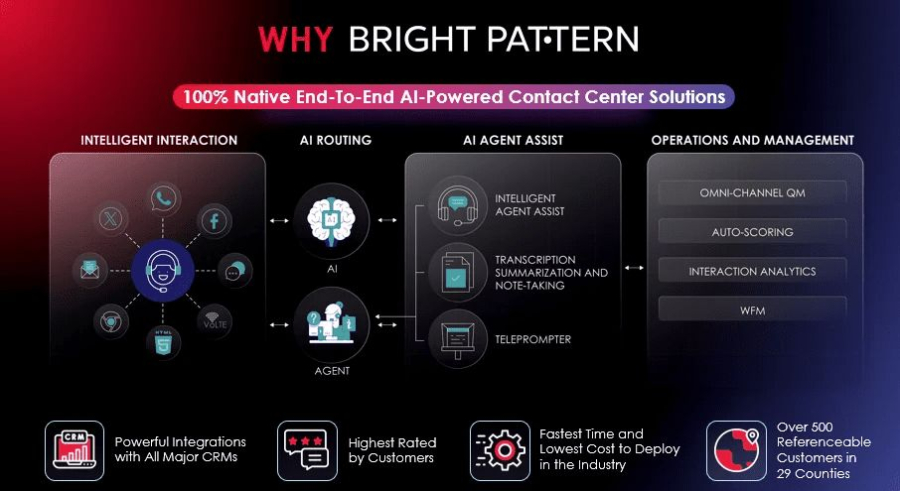
Bright Pattern stands out as a leading provider of AI call centre software, offering a comprehensive suite of contact center solutions that enhance both customer and agent experiences. With its focus on omnichannel support, Bright Pattern allows businesses to deliver seamless interactions across voice, chat, email, SMS, and social media.
Key benefits include:
- Intelligent routing to connect customers with the right agent quickly
- AI-powered virtual agents to handle routine inquiries and reduce wait times
- Advanced analytics to track performance and identify improvement areas
- Easy integration with CRM and business tools for a unified experience
- Scalable solutions suitable for businesses of all sizes
Bright Pattern’s platform is designed to help organisations implement AI in contact centers efficiently, improving service quality and operational efficiency simultaneously.
2. Genesys Cloud
A leading cloud-based contact center platform with AI-driven routing and analytics. Ideal for businesses seeking scalable, omnichannel customer support.
3. Five9 Intelligent Cloud Contact Center
Offers predictive dialing, AI-powered chatbots, and real-time analytics to enhance agent performance and customer satisfaction.
4. Talkdesk CX Cloud
Provides AI-powered workflows and automated interactions that simplify call handling while maintaining high-quality service.
5. NICE inContact CXone
A unified platform combining AI automation, workforce optimization, and advanced reporting for smarter contact center operations.
6. RingCentral Contact Center
Focuses on cloud-based AI solutions with omnichannel support, real-time analytics, and integration with popular CRM systems.
7. 8x8 Contact Center
Delivers AI-driven insights, automated call routing, and self-service options to streamline customer interactions.
8. Avaya OneCloud CCaaS
Provides AI-enhanced contact center solutions, enabling personalised customer experiences and efficient agent workflows.
9. Cisco Contact Center
Combines AI-powered automation and robust analytics to improve call resolution times and customer engagement.
10. Zoom Contact Center
Supports AI-driven workflows and virtual agents to provide seamless, multichannel customer support.
What Is AI Call Centre Software?
AI call centre software uses artificial intelligence and machine learning to automate, augment, and optimise customer interactions. It sits at the heart of a modern contact centre and works across voice and digital channels to understand customer intent, route conversations, assist agents, and surface insights.
Typical AI components in a call centre technology stack include:
- Conversational AIthat powers virtual agents and chatbots for voice and digital channels.
- Natural language processingthat understands what customers say or type, even when they use everyday language.
- Machine learning modelsthat predict outcomes, recommend next best actions, and continuously improve based on new data.
- Intelligent routing enginesthat send each contact to the best resource, whether that is a bot, a human agent, or a specialised queue.
- Real-time analytics and quality monitoringthat surface trends, risks, and opportunities across every conversation.
Instead of replacing human agents entirely, leading AI call centre platforms focus on combining the strengths of automation and human empathy. Routine tasks are handled by intelligent automation, while people focus on complex or emotionally sensitive interactions.
Why AI-Powered Call Centres Are Transforming Customer Service
AI call centre software directly addresses the biggest pain points in traditional contact centres, while opening new opportunities for growth and differentiation.
- Faster responses and resolutionsas virtual agents handle simple queries instantly and agent assist tools help humans solve complex issues more quickly.
- 24 or 7 availabilitywithout needing to staff every time zone, enabling customers to get help whenever they need it.
- Consistent experiencesbecause AI follows defined policies and workflows, reducing variation in how issues are handled.
- Highly personalised interactionsusing customer history, preferences, and behaviour to tailor each response.
- Lower operating costsby automating repetitive work and increasing agent productivity.
- Happier, more engaged agentswho spend less time on mundane tasks and more time solving interesting problems.
- Actionable insights at scalethanks to analytics that process thousands of conversations, not just a small sample.
When designed thoughtfully, AI does not just make the call centre more efficient. It turns the contact centre into a strategic asset that builds loyalty and unlocks new revenue.
Core Capabilities To Look For in AI Call Centre Software
Not all AI solutions are created equal. When evaluating platforms, focus on capabilities that directly support your customer and business goals.
Conversational AI and Virtual Agents
Modern AI call centres often start with conversational bots that can handle natural, free-flowing dialogue over voice or digital channels.
- Voice botsthat greet callers, authenticate them, and resolve common requests without human intervention.
- Chatbots and digital assistantsembedded in messaging apps, web chat, or mobile apps.
- Intent recognitionso the bot understands what a customer is trying to achieve, even when they do not follow a script.
- Seamless hand-offs to agentswith full context when the conversation becomes too complex for a virtual agent.
The best conversational AI feels natural, handles multiple turns in a conversation, and gracefully hands off to humans when needed.
Intelligent Routing and Queuing
Routing can make or break the customer experience. AI-driven routing looks at many data points to decide where each interaction should go.
- Skill-based and intent-based routingto match each customer with the agent or bot most likely to resolve the issue.
- Customer value or priority routingthat considers lifetime value, current sentiment, or service level agreements.
- Dynamic queue managementthat adapts to volume spikes and rebalances workloads in real time.
Smart routing improves first contact resolution, shortens wait times, and ensures high value interactions get the attention they deserve.
Agent Assist and Real-Time Coaching
Agent assist tools use AI to work alongside agents during live calls or chats, giving them instant support and guidance.
- Real-time transcriptionof voice calls, making it easier to follow complex issues and search conversation history.
- Suggested responses and knowledge articlesthat appear based on what the customer is saying or typing.
- Compliance prompts and alertsthat remind agents of disclosure requirements or restricted phrases.
- Live sentiment analysisthat flags when a conversation is going off track so supervisors can step in.
With strong agent assist capabilities, even new hires can perform like experienced agents more quickly, reducing onboarding time and improving customer outcomes.
Omnichannel Orchestration
Customers move between channels constantly. AI call centre software should orchestrate experiences across voice, email, messaging, and social platforms.
- Unified customer profilesso agents and bots see the full interaction history, regardless of channel.
- Cross-channel continuitywhere a customer can start in chat, move to voice, and never repeat information.
- Channel optimisationso simpler requests are encouraged to use self-service, while complex issues reach live agents quickly.
This orchestration creates a smooth, connected experience that customers remember positively.
Workforce Management and Forecasting
AI is also powerful behind the scenes in workforce planning.
- Forecasting contact volumesusing historical data, events, and trends.
- Optimised schedulingthat balances coverage, employee preferences, and cost.
- Intraday managementthat adjusts staffing and routing rules on the fly as conditions change.
By pairing AI-driven self-service with smarter staffing, you can handle more interactions without sacrificing service quality.
Analytics, Reporting, and Quality Management
Every interaction contains valuable information. AI call centre software helps you unlock it.
- Speech and text analyticsthat mine conversations for themes, root causes, and sentiment trends.
- Automated quality scoringacross all calls and chats, not just small samples.
- Performance dashboardsfor agents, supervisors, and executives with metrics that matter.
- Journey analyticsthat show how interactions connect across channels and touchpoints.
These insights enable continuous improvement, better training, and more strategic decisions about products, policies, and processes.
Feature and Benefit Snapshot
AI Capability | Primary Benefit | Example Impact |
Virtual agents and chatbots | Always-on self-service | Customers reset passwords or check orders without waiting in a queue. |
Intelligent routing | Higher first contact resolution | Issues reach the right agent or bot the first time. |
Agent assist | Faster, more confident agents | Suggested replies help agents handle unfamiliar queries. |
Speech and text analytics | Stronger voice of the customer insights | Recurring complaints reveal where to improve products or policies. |
Workforce optimisation | Lower staffing costs | Better scheduling reduces overtime and understaffed peaks. |
High-Impact Use Cases for AI Call Centre Software
AI can enhance almost every part of the contact centre. These use cases tend to deliver strong, visible value quickly.
24 or 7 Self-Service for Common Requests
Virtual agents are ideal for high-volume, low-complexity enquiries such as:
- Account balance checks and basic account updates.
- Order status and delivery tracking.
- Appointment booking, confirmation, and cancellation.
- Password resets and simple troubleshooting steps.
By automating these interactions, live agents are free to focus on conversations where they add the most value.
Handling Peak Season and Unexpected Spikes
Seasonal peaks and unexpected surges can overwhelm traditional contact centres. AI helps you scale gracefully by:
- Absorbing a large portion of simple calls and chats with virtual agents.
- Prioritising high urgency or high value contacts for human agents.
- Automatically adjusting routing rules and self-service options as demand changes.
This flexibility helps you maintain service levels without overhiring or overstaffing for the rest of the year.
Proactive Customer Outreach
AI call centre platforms can also be used to reach out to customers before they call you.
- Proactive notifications about delays, outages, or policy changes.
- Follow-ups after a purchase or service appointment.
- Renewal reminders, upgrade offers, or loyalty programme updates.
When proactive communication is managed intelligently, it reduces inbound volume, boosts satisfaction, and can generate additional revenue.
Technical Support Triage
In technical or product support environments, AI can triage cases before they reach an expert.
- Gathering key details about the device, software version, or environment.
- Running basic troubleshooting steps with the customer.
- Routing unresolved issues with full context to the right specialist queue.
Experts then spend more time solving complex issues and less time on initial questioning.
Collections, Billing, and Payment Assistance
For billing or collections teams, AI offers a scalable, consistent way to engage customers while respecting rules and policies.
- Automated payment reminders with self-service options.
- Polite, policy-compliant outreach about overdue accounts.
- Routing sensitive or disputed cases to trained human agents.
This approach improves recovery rates while reducing the stress often associated with these conversations.
How AI Call Centre Software Improves Key Metrics
Well-implemented AI call centre solutions typically drive improvements across both customer experience and operational performance. Organisations commonly track gains in the following areas.
- Customer satisfaction and experienceas measured by surveys, sentiment analysis, and repeat business.
- First contact resolutionthanks to better routing, knowledge, and agent support.
- Average handle timereduced by automating data entry and surfacing answers faster.
- Abandon rateslowered because customers can self-serve or get routed more efficiently.
- Cost per contactreduced by combining automation with higher agent productivity.
- Revenue per contactincreased through better cross-sell or upsell recommendations.
- Agent engagement and retentionimproved by reducing repetitive work and providing better tools.
The exact impact will vary by industry and starting point, but the directional benefit tends to be consistent when AI is aligned with a clear strategy and strong execution.
Implementation Roadmap: From Idea to Live AI Call Centre
Moving to an AI-powered model is a journey, not a single project. A structured roadmap reduces risk and speeds up results.
1. Clarify Objectives and Success Measures
Start by defining what success looks like for your organisation.
- Is your top priority reducing wait times, improving satisfaction, or lowering costs.
- Which metrics will you track, such as first contact resolution, handle time, or containment rate.
- How will you combine customer, operational, and financial measures.
Clear goals help you choose the right use cases and communicate value to stakeholders.
2. Assess Your Current Contact Centre Environment
Review your existing systems and processes.
- Telephony and contact routing platforms.
- Customer relationship management systems and ticketing tools.
- Knowledge bases, scripts, and process documentation.
- Data sources such as call recordings, chat logs, and customer profiles.
Understanding your baseline helps you identify integration needs and quick wins.
3. Prioritise High-Value Use Cases
Rather than trying to automate everything at once, focus on a small number of high-impact scenarios.
- High-volume enquiry types where answers are standardised.
- Processes with clear rules that can be followed by a virtual agent.
- Agent workflows that are slowed down by manual lookups or data entry.
Delivering early wins builds momentum and confidence in AI across the organisation.
4. Prepare Data, Knowledge, and Integrations
AI is only as strong as the information and connections behind it.
- Consolidate and clean knowledge articles, FAQs, and policy documents.
- Define how AI will access customer and transaction data in real time.
- Ensure integrations with your telephony, customer systems, and case management tools.
This foundation ensures that bots and agent assist tools provide accurate, current answers.
5. Design Conversations and Workflows
Work closely with operations leaders, frontline agents, and customer experience teams to design how interactions should flow.
- Map common journeys from the customers perspective.
- Define where automation should lead and where humans should step in.
- Write clear, empathetic bot responses that match your brand voice.
Thoughtful design helps AI feel like a natural part of your service, not a barrier.
6. Pilot, Learn, and Iterate
Launch pilots with limited scope or audiences before rolling out widely.
- Monitor performance metrics and customer feedback closely.
- Review transcripts and call recordings to refine intents and flows.
- Engage agents and supervisors in providing feedback on what works and what does not.
Iteration is essential. AI models and conversation designs improve as they encounter real-world scenarios.
7. Train and Support Your People
Successful AI adoption depends heavily on agents and supervisors feeling informed and supported.
- Explain how AI will help them, not replace them.
- Provide hands-on training in using new tools like agent assist dashboards.
- Update performance metrics to recognise collaboration with AI, not just volume of contacts handled.
When teams understand the benefits, they are more likely to embrace the change and share ideas to enhance it.
Buyer Checklist: Evaluating AI Call Centre Solutions
When comparing platforms, use a structured checklist to see which solutions fit your needs best.
- Channel supportDoes the platform support the voice and digital channels that matter most to your customers.
- Integration capabilitiesHow well does it connect with your telephony, customer systems, and knowledge bases.
- Ease of configurationCan your team build and adjust flows without deep technical skills.
- AI quality and transparencyAre models accurate, explainable, and regularly updated.
- Security and complianceDoes the vendor meet your requirements for data protection, privacy, and industry regulations.
- Scalability and reliabilityCan the platform handle your peak volumes and growth plans.
- Analytics and reportingAre insights clear, actionable, and aligned to your business goals.
- Support and success servicesWhat help is available for design, training, and optimisation.
A structured evaluation process leads to a solution that not only looks impressive in a demonstration but performs in everyday operations.
Common Concerns and How to Address Them
AI call centre software introduces change, and it is natural for teams to have questions. Addressing concerns openly builds trust.
Will AI Replace Human Agents
In most organisations, AI is used to augment agents, not eliminate them.
- Automation handles repetitive, low-value tasks.
- Agents focus on complex, high-value, or emotionally sensitive interactions.
- New roles often emerge in bot design, analytics, and quality improvement.
Framing AI as a digital teammate rather than a replacement helps reduce anxiety and resistance.
Can AI Deliver Quality, Human-Like Service
Quality depends on good design, strong knowledge, and ongoing tuning.
- Use simple, clear language in bot conversations.
- Provide easy options to reach a human when needed.
- Regularly review conversations for tone, clarity, and accuracy.
Over time, AI interactions can feel natural and helpful, especially for straightforward tasks where speed matters most.
How Do We Stay Compliant and Protect Data
Security and compliance should be central to any AI call centre initiative.
- Work with vendors that follow strong security practices and support your industry standards.
- Define clear policies for data retention, access, and masking of sensitive information.
- Use analytics responsibly, focusing on patterns and behaviours rather than intrusive monitoring.
With the right controls, AI can actually strengthen compliance by applying rules consistently.
The Future of AI Call Centres
AI in contact centres is still evolving quickly. Emerging trends point to even more powerful and seamless experiences.
- Deeper personalisationby combining interaction data with broader customer context.
- Predictive servicethat identifies and resolves issues before customers notice a problem.
- Advanced agent supportblending coaching, performance insights, and personalised learning paths.
- Tighter alignment with the wider businesswhere insights from conversations shape products, pricing, and marketing.
Organisations that invest in AI call centre capabilities now will be better positioned to ride this wave of innovation rather than playing catch-up later.
Conclusion: Turning Your Call Centre into a Strategic Advantage
AI call centre software is far more than a cost-saving tool. When implemented thoughtfully, it becomes a powerful engine for customer loyalty, brand differentiation, and sustainable growth.
By combining intelligent automation with empowered human agents, you can:
- Respond faster and more accurately to every customer.
- Deliver consistent, personalised experiences across channels.
- Unlock insights that improve products, policies, and journeys.
- Create a work environment where agents feel supported rather than overwhelmed.
Whether you are modernising an existing contact centre or building an AI-first operation from the ground up, the opportunity is clear. The sooner you start, the sooner your call centre can move from being a cost centre to becoming a strategic asset that delights customers and drives business results
